Showing posts with label My Favourite Bruckner Recordings. Show all posts

29 July 2011

My Favourite Bruckner Recordings (episode 10) -- Symphony No. 4 in E flat Major -- Reflections

Symphony No. 4 (Romantic) is one of Bruckner's most popular symphonies, and hence it has been copiously recorded. As such it is a Herculean task to choose my favourite recordings of this symphony. In fact most of the recordings are of a high standard, and the choices will very much depend on personal taste. (Please read the Remarks at the bottom of the list as well.)


1874 Version

[Nowak (1975) edition]
Michael Gielen / SWF-Sinfonieorchester Baden-Baden (4/1994)

(Intercord CD 860.925)


A brief review of this recording together with a brief history of the revisions Bruckner made for this symphony, resulting in the different versions, was posted in Nov 2009:


1878/1880 Version

[Haas (1944) edition]
Herbert Blomstedt / Staatskapelle Dresden (7-11/9/1981) 

(Denon COCQ-84539 HQCD)

(Dal Segno DSPRCD045)


This is Blomstedt's second Bruckner recording made under the cooperation of Denon, Japan and (VEB) Deutsche Schallplatten, Germany, the first being B7 recorded one year earlier. Recorded in the Lukaskirche, Dresden, it benefits from the excellent acoustic of the venue. The Staatskapelle Dresden is luminous here. The string sound is warm and the brass timbre is lovely. Blomstedt is musically expressive, without losing his usual prudence.

The HQCD sounds best among the 3 versions of the same recording that I have. The bass is more solid and the strings are even warmer. The whole recorded sound becomes more engaging and realistic. The Dal Segno CD is satisfactory in sound, but the Denon HQCD's is superior.


Otmar Suitner / Staatskapelle Berlin (1-2/1989)

(Berlin Classics 0011612BC)

(King KICC3533)

It is a digital recording made in Christuskirche, Berlin-Oberschöneweide, less than a year before the fall of the Berlin Wall, in the former East Berlin. This church is well known for its excellent acoustics and had been at one time used solely as a studio for the VEB Deutsche Schallplatten Berlin before its community function was restored after the reunification of Germany. It should not be confused with the Jesus-Christus-Kirche (or Jesus Christ Church in English) in Berlin-Dahlem, situated in the former West Berlin, where many famous Deutsche Grammophon and Karajan recordings were made. The Christuskirche provides a very warm but transparent sound with good definition of the different instruments as evident in this recording. Otmar Suitner may not be very well-known in the West in the past, but his art has been gaining much appreciation thanks to an easier availability of his recorded legacy in CDs issued by Berlin Classics.

One of the key elements in his art is the naturalness and liveliness he brings to the music. This Bruckner 4th is an excellent example of it. The opening movement is truly "bewegt". There is not a hint of idiosyncracy in the interpretation, yet it is never bland. I'm much impressed by the sound and playing of the brass which is cultured yet also very incisive.  I'm lucky to have attended quite a number of concerts of the Staatskapelle Berlin and I hold the sound of this orchestra dear to my heart: the dark hue of the strings complemented by the sonorous cellos and basses, the Eastern European feel of the woodwinds and the cultured yet incisive brass described above. I affectionately depict its sound in my mind as analogous to amethyst gold. This recording has admirably captured this amethyst gold sound colour of this orchestra. 

When I compared this recording with Barenboim's 15/10/2008 live recording with the same orchestra (in-house label, SKB-0001), the difference is enormous. The orchestra still played superbly in the new recording, but Barenboim's management just verged on mannerism and over-inhibition. In the exposition of the Finale, the music is lively almost to the degree of being exorbitant under Suitner, whereas it becomes lame and lackadaisical in Barenboim's hands. 

A regular reader of this blog, eaquson from Taiwan, has told me the better sound quality of these VEB Deutsche Schallplatten recordings in CDs issued by other labels compared to those by Berlin Classics. This prompted me to try the Japanese version issued by King of this recording. The difference is not very obvious, maybe because my playback system is not up to it, but I can discern a more crystalline sound in the upper frequencies, a more powerful bass and better resolution of instruments in the middle frequencies. As this recording is one of my favourites, I think it is well worth the extra outlay.


Günter Wand / NDR Symphony Orchestra (28-30/10/2001)

(BMG 93041 2; 2-CD)


A certain type of recordings somehow seems predestined to remain in the memory of Brucknerites for aeons. The last studio or concert recordings of many conductors belong to this group. Wand's last recording of his concerts from 28 to 30 October 2001 of Bruckner's 4th Symphony certainly is one of them. Other examples that come to mind include Karajan's last B7, Jochum's last B5, and Sinopoli's and van Beinum's last and only B5.  These are all truly memorable recordings, and in the case of Karajan's and Jochum's, they pluck at your heart-strings that their respective earlier recordings didn't quite manage to do so at such intensity. Wand's BPO recording of B4 is a towering achievement and has become an indispensable part of my collection once I got it. This last recording of Wand's is no less essential. When I listened to it again recently, I was simply speechless with the performance, particularly the Andante where everything seemed so right in place, and I was just like a fool sitting there beaming with perfectly undiluted satisfaction with what I had just heard.


[Nowak (1953) edition]
Claudio Abbado / Lucerne Festival Orchestra (18-19/10/2006)

(Lucerne Festival Edition 120455)

Abbado's previous Bruckner recordings with VPO on DG have received some criticisms despite their merits, and for whatever reasons, his last commercial Bruckner recording was 15 years ago in 1996. After he left Berlin, his cooperation with the Lucerne Festival Orchestra transcended almost all his previous efforts to a sublime artistic level which many marvel at. His "new" Mahler recordings, now on DVD, with this orchestra were lauded as among the best, if not the best.  

This Bruckner 4th is also in the same league. Recorded live in Suntory Hall, Tokyo, and benefitted from its excellent acoustics, the sound is lush and warm yet at the same time limpid. If you agree to William Blake's idea that "exuberance is beauty", then this performance is utterly beautiful because it is a quintessential example of what exuberance is all about, in orchestral ensemble, sound and (Schubertian) colour, in musical expression and commitment, and in sheer radiance and exhibition of positive energy. 


Karl Böhm / Wiener Philharmoniker (19/11/1973)

(Decca Ovation 425 036-2)


This recording really needs no introduction to Brucknerites. The good things about his Bruckner 3rd recording with this orchestra on the same label can all apply to this justly famous recording. Its merits and the joy it brings to the listener are long lasting. 


Eugen Jochum / Bavarian Radio Symphony Orchestra (3-5/10/1955 Mono)

(DG 469 389-2)

This mono recording is not handicapped by the technology of the time. Here Jochum leading his orchestra in the early post-war years has brought us a performance of immense sparkle and a recording in very good mono with fine details. The orchestral sonority has a great nostalgic feel to it, decorated with a sonorous lustre. There are many delicate touches by Jochum here, e.g. in the early part of the development (bars 193-216). The special thing about this recording among Jochum's many is the way he played the music, in a fine balance of blissful abandon and an intensity of spirit, from the pianissimos to the building up of climaxes. It is a joyful musical journey free of the unnecessary brooding that mars many other recordings. It is also a very smooth musical journey devoid of the stop-and-go stigma that was awarded to Jochum by many critics for his later efforts. But above all it is a musical journey that I'm more than happy to travel again and again.


Wolfgang Sawallisch / The Philadelphia Orchestra (3/1993)

(EMI CDC 5551192)

I posted this picture with a heavy heart because of the sad news that The Philadelphia Orchestra filed for bankruptcy just a few months ago -- an orchestra once famous all over the world for its golden sound has now become a failing business. An embittered irony; a disillusionment of the battle between art and business.

The choice of this disc is of course not because of Sawallisch's autograph. In fact it is the other way round. I loved this recording and so I asked him to autograph this particular CD booklet. Compared with their European counterparts, American orchestras (even the "Big 5") do not make many Bruckner recordings, and even fewer truly memorable ones. Not so for this one by Sawallisch. It is a slow burning affair. The first three movements get a no-nonsense treatment but still you can bathe yourself in the golden sound of the orchestra. However when it reaches the Finale, everything springs to life. Great recordings owe their greatness to great moments, and it is exactly the case here in the Finale. A glorious tribute to this famous orchestra.


Remarks:
1) The catalogue numbers are those of the CDs in my collection. There may be other versions of a particular recording by the same label or even other labels, with a different catalogue number.

2) Not included in the list are those 'sets' I considered en bloc; see episodes 3 (link) and 4 (link). Special mention must be made of Günter Wand's Berlin Philharmonic recording which is my best loved among all his BPO Bruckner recordings. 

3) Selections for this symphony are based on a database of a guilty number of 112 distinct recordings, excluding single movements, e.g. 1878 Volkfest Finale, and transcriptions.

23 June 2011

My Favourite Bruckner Recordings (episode 9) -- Symphony No. 3 in D minor


Here is the list categorized by the versions employed in the recordings:


1873 version 

[Nowak (1977) edition]
Herbert Blomstedt / Gewandhausorchester Leipzig (3-4/9/1998) (Querstand VKJK 0507 - CD1 of a 5CD set)

If you browse through Bruckner's huge discography, it is indeed quite unusual to see a venerated Brucknerian 'of the old school' and an orchestra with a long history of Brucknerian heritage playing or recording the first versions of the Third or the Fourth. Not so for Blomstedt and the Gewandhausorchester Leipzig. Georg Tintner, during my interview, asserted that the first version of Symphony No. 3 was the best among all its versions and that each subsequent revision just made it less good. However the acceptance of this 1873 version takes time and its recordings are relatively few compared with the later versions. A glance at Mr John Berky's complete discography will give you an idea (www.abruckner.com).

It is a truly engrossing performance. It is a showcase of the excellent ensemble and mesmerising sound of the Gewandhausorchester Leipzig. The opening of the first movement exudes a special aura when the trumpet theme is bathed in a sea of rich bass. How beautiful Blomstedt shapes the second thematic group (beginning 4'22"). The final peroration, contrasted with the quiet phrases before it, is so enriching. The violas towards the end of part 2 in the Adagio are riveting (6'29"). The dance rhythm in the Trio (beginning 2'15") just shows us that it is not unique to the Vienna Philharmonic to play it so idiomatically; the Leipzig players are also up to it. In the Finale, the urgency of the third theme (beginning 4'40") contrasts well with the second, a delicate touch not very common in other performances. The heaven opens in the coda, particularly at the moment when the first theme of the opening movement is recapped. The music is followed by a long applause when it ends at 15'10".


1877 version

[Nowak (1981) edition]
Guiseppe Sinopoli / Staatskapelle Dresden (4/1990) (DG 431 684-2)

My encounter with this disc was a strange accident of fortune almost 20 years ago. It has remained a treasure in my mind ever since. A truly memorable recording. The Dresden strings, the East European timbre of the woodwinds and horns, and a detailed yet plush and flowing reading form a wonderful combination that is rarely found in other conductor-orchestra pairings.

Sinopoli's buildup of the crescendo in the first thematic group of the Adagio is a goose-pimples-inducing experience yet to find in other recordings in my collection (up to now 62 B3s).


Michael Gielen /  SWR Sinfonieorchester Baden-Baden und Freiburg (3-5/5/1999) (Hänssler CD 93.031)

Gielen's reading is lithe and lean, full of details that you cannot hear in many other performances. He makes you aware of the Schubertian and Beethovenian roots in this symphony and here the orchestra plays with an ardour to match. The rhythmic drive is exorbitant but it never sounds hard-driven. It also imparts a sense of modernity to this symphony, looking far beyond the period in which it was written. A pleasant contrast to Sinopoli's.


[Oeser (1950) edition]
Rafael Kubelik / Bavarian Radio Symphony Orchestra (30/1/1970) (Audite 92.543 SACD)

Kubelik's antiphonal placing of the violins is a nice and heart-winning touch, not just in Bruckner's symphonies, but also in Brahms', so much evident in his set of symphonies issued by Orfeo. There are always moments of impact, thanks to his expressive fervour combined with a nobility of tone in his sound palette. Constantin Floros has written that "the most outstanding characteristic of the Third Symphony must be the enormous abundance of its contrasts". And Kubelik simply excels in this regard, exhibiting a nice balance of light and shade, particularly in the Adagio. The SACD sound, not to speak of letting us compare the edited and original versions of the recording in different tracks on this disc, is a generous bonus.


1889 version 

[Nowak (1958) edition]
Karl Böhm / Wiener Philharmoniker (9/1970) (Decca 448 098-2)

This famous recording needs no introduction. I've always felt that the truncated 1889 version's Finale needs someone who plays with ardour to gel the rather unconvincing gaps together. Böhm is exactly this person. His Bruckner never disappoints me, from his pre-war recordings of B4 and B5, to his Vienna Philharmonic's recordings in the 1970s and also his miraculous performance with the Zurich Tonhalle Orchestra in 1978 (Palexa CD-522). In his readings of Bruckner's symphonies, you can sense his almost palpable conviction, an attribute that brings life to his studio recordings and an exuberant soul to his live performances. 'Fussy', 'fusty' and 'fuzzy' are not words in his dictionary because he never drags, dawdles or dulls the music of Bruckner.

The playing of the Vienna Philharmonic is full of splendour here, and shows why they are famous in Bruckner. The recording is immediate and vibrant, capturing the full glory of this orchestra. It is almost superfluous to praise Böhm's mastery of the Austrian idiom in the Trio and the polka in the Finale. What else can you ask for?

 
[Rättig (1890) edition]
Kurt Sanderling / Gewandhausorchester Leipzig (6/1963) (Berlin Classics BC 2151-2)

Sanderling gives us a true misterioso in the first movement. I'm also impressed by the vigour in the reading. There is always a sense of direction, a point almost too obvious and yet unfortunately is lacking in too many readings I encountered. His good use of the Generalpauses adds to the sense of structure so much evident in this recording. The woodwind timbre has a melancholic feel to it. The strings are beautiful, as in the opening passages in the Finale. A vintage choice.


Carl Schuricht / Wiener Philharmoniker (2-4/12/1965) (Medici Arts MM016-2); (EMI TOCE-3404)

Again this recording needs no introduction. Exciting, forward-moving and restrained grandeur are terms I can think of to describe this performance. The Medici Arts remastering is a marked improvement on the Japanese transfer.


Remarks:
1) The catalogue numbers are those of the CDs in my collection. There may be other issues of a particular recording by the same label or even other labels, with a different catalogue number.

2) Not included in the list are those 'sets' I considered en bloc; see episodes 3 (link) & 4 (link).

3) Selections for this symphony are based on a database of 62 distinct recordings, excluding single movements, e.g. 1876 Adagio, and transcriptions.

I welcome your sharing of your favourites. Please leave your comments. Thank you.


(The old Episodes 9a & 9b combined) 

14 June 2011

My Favourite Bruckner Recordings (episode 8) -- 'Disclaimer'

When I compiled this list, I tried as much as possible to have no preconceived ideas on any particular conductors or orchestras. I even asked my family to randomly choose some CDs and played them for me as a blind test. This practice had an added fun element in it -- I could try to guess who the conductor or what the orchestra was after jotting down my impressions.

At this point I have to thank my beloved wife Flora for her understanding and adopting a laissez-faire attitude towards my seemingly endless, lavish act of acquiring these CDs one after another.

It is natural that my choices are only restricted to those recordings I've listened to. My collection consists almost entirely of official commercial releases. However, I do have some CDs from pirate labels, but they amounted to less than 30 and were purchased long ago for special reasons, e.g. before the EMI releases of Celibidache's recordings, or recordings from conductors I like very much. They are from Arkadia, Audior, Bells of St. Florian, and a couple more which I cannot recall at this moment. On the other hand, I've never had CDs from labels like Dirigent, Antec Music, En Larme, etc. Apart from that there must be many commercial releases that I do not own. So there is no pretension whatsoever to exhaustiveness.

Everyone knows that all favourite lists are personal. They depend on the taste of the compiler and they differ in 'objectivity' only in a matter of degree. No lists will be purely objective, but some lists can be purely subjective. And I hope mine is somewhere in between.

My list will inevitably include some well-regarded recordings: they are considered as such for good reasons. But my list also includes some conductors who may not be the first names to come to mind as Brucknerians, but their recordings, especially some live performances, are believed to be ones that any serious Brucknerite will beseech.

Remember in episode 2 I mentioned that some conductors were not included in this list because their Bruckner recordings were considered in a league of their own: Furtwängler, Celibidache, Tintner and Wand in his Berlin Philharmonic recordings. 

I'll begin with Bruckner Symphony No. 3 in D minor.
  

31 May 2011

My Favourite Bruckner Recordings (episode 7b) -- Not-my-favourite diversions

The pun in the title is not entirely intended, but it nevertheless reflects some truth in it. Talking about these 5 'unique' recordings is a diversion from the original topic of my favourite Bruckner recordings. On the other hand, some of these CDs can become something that amuses me when I feel like listening to them.

Let's go through the 'unique' discs listed in episode 7a one by one.


This live recording was made in 1977 when the Radio-Symphonie-Orchester Berlin was in that seven-year 'dark' period of not having a single principal conductor.  The immaculate ensemble cultured by Ferenc Fricsay in the fifties and early sixties was unfortunately nowhere to be found in this performance, although it was not bad. Richter gave us one of the slowest first movements of Symphony No. 4 at 22'13". To get an idea of how slow it is, it is even slower than Celibidache's on EMI (21'56") and three minutes longer than Wand's with the Berlin Philharmonic (19'11"). Fortunately Richter could usually maintain a long line in this symphony. The second movement was taken as the andante it was intended to be, but the Scherzo was too broad to my taste, even verging on sluggishness. Abbado and the Lucerne Festival Orchestra were definitely more delectable with its pretty exuberance here. The Finale glided along with a tempo rather disproportionate to the slow tempo of the first movement.


Gerhard Pflüger's was the Principal Conductor and Artistic Director of the Leipzig Radio Symphony Orchestra from 1949 to 1957. This Bruckner Fifth CD was based on a Urania LP issued soon after the recording was made in 1952. The sound of this CD has a limited dynamic range with quite a significant cutoff in the treble and bass. As a result, the chorale in the Finale becomes underwhelming. The reading is quite orthodox without much personal characterization.


Bongartz's Bruckner 6th enjoyed almost a cult status among some fans, of course with some good reasons.

Without doubt, he gave us a very beautiful Adagio. Here, the music is almost enlivened into a living creature because it can weep and lament (what wonderful oboe playing!) in the first theme, sing in the second and dance and run in the third. It is also endowed with a regular steady pulse, a key attribute of Bongartz. I've more than once in the past played this Adagio alone to my intense enjoyment. If the Adagio is so good why doesn't this recording become one of your favourites, I can almost hear you ask? The problem is you have to go through the inhospitable tempestuous terrain in the first movement before you can arrive at the oasis of the Adagio. The terrain may be inhospitable to me but it has proved to be heaven for others. The first brass outburst, yes outburst, in the first movement is frightening and indeed startling. If it happens once, I may still call it special effect to enhance the excitement, but if it recurs and recurs later in the movement, I can only take it as hysterical, especially after I've listened to the 'normal', beautifully played movement that follows. Bruckner is not a temperamental person after all, is he? Furthermore, compared to the mellow sound Blomstedt honed from this orchestra, you can never tell it was the same Gewandhausorchester Leipzig.

If you relish such exciting bombardment in Bruckner Sixth, you've found the right record. You need not look further.


Muhai Tang may be the only Chinese conductor to have recorded a Bruckner symphony. He could maintain a nice long line in this symphony. The cello theme in the opening movement is very lyrical and the third theme beautiful. Perhaps in an attempt to sustain legato throughout, he did not allow adequate space between phrases in the development section. The coda is glorious however. The Adagio has its moving moments despite the feeling that he sounded a little hurried here. The orchestra, its good ensemble notwithstanding, is light on bass and this weakness is more the apparent in the Adagio. The remaining two movements are eloquent enough. I'd say this reading is unexpectedly good and in particular lyricism shines through. Although I didn't include it as one of my favourites, I enjoyed it very much.


It is a special recording. It would not be overstating to say that Delman is an iconoclast in Bruckner. His approach to Bruckner is beyond what one is used to in the many recordings that come before or after his.

In the first movement, the opening is muted, with the string tremolo almost inaudible. The brass playing is acceptable, but just here. In the second thematic group where usually the strings carry the melodic line, Delman changed the emphasis constantly, sometimes to the woodwinds, sometimes to the lower strings and then to the horns. He went on to exert much personal rubato in the third thematic group. His tempo is quite slow in this movement but you don't really feel it this way, because your attention is diverted to different sections of the orchestra he highlighted as the music unfolds. The Scherzo shows the limitation of the orchestra and the ensemble barely keeps itself together in the slower pulse, losing much of the urgency expected. There is no doubt that Delman was much engrossed by the music as he was almost singing along with the orchestra in the Adagio. However he was let down by the inadequate strings, especially the cellos which are so important in this great movement, and the unsteady pulse. It is surely a recording that will satisfy my curiosity rather than my taste. Maybe I'm too stupid because I still struggle to understand the message Delman wanted to tell us even after listening to the disc a couple of times.
  

25 May 2011

My Favourite Bruckner Recordings (episode 7a) -- Rarity is not a criterion

It doesn't require the sharp mind of Sherlock Holmes to diagnose self-aggrandizement in the classical music world, from players on stage to listeners at home next to a pair of speakers. Nor, indeed, does it need an insightful mind to see that rarity has often been equated with supremacy in recorded classical music. Hard-to-find records have been hailed as treasures unable to be appreciated by the Tom, Dick and Harry in music lovers -- these rare finds are hors concours recognised only by the connoisseur. That's nothing wrong with someone enjoying his/her rare gems. However, as usual, life is not so simple. Problem arises when these 'knowledgeable' persons assume that all-too-familiar condescending attitude towards their poorer fellow listeners who cling to their common and popular records.

How familiar it is to hear " You like Wand and Karajan right? Oh yeah you people usually do. Have you ever heard of so-and-so?" Popular choices are considered low taste, and the same applies to modern recordings compared to old ones. Just as the premise that everything old is good in classical music recordings is based on the skimpiest of underpinnings, not everything rare, or simply just hard-to-find, must be good either. I'll take five examples to illustrate this point. These 5 conductors each have only one extant Bruckner symphony recording up to this moment. Aside from one record, by Heinz Bongartz, which is still available only in a box-set of 8 CDs in some areas, and another, by Karl Richter, which is available only in Japan, all the rest are out of print at this moment. Most of these recordings have been eulogised as the 'best' in the respective symphony somewhere over the internet. My purpose of commenting on these 'unique' recordings is not to taunt those immensely satisfied listeners, far from it, but just to present a different view to balance the picture.

These 5 CDs are:
1) Symphony No. 4: Karl Richter, Radio-Symphonie-Orchestra Berlin, live 7 Nov 1977 (Altus ALT068)
2) Symphony No. 5: Gerhard Pflüger, Leipzig Philharmonic Orchestra, 3&4 Apr 1952 (Dante LYS 417)
3) Symphony No. 6: Heinz Bongartz, Gewandhausorchester Leipzig, Dec 1964 (Berlin Classics 0184512BC)
4) Symphony No. 7: Tang Muhai (湯沐海), Queensland Symphony Orchestra, 22&23 Nov 1996 (ABC Classics CD 456 664-2)
5) Symphony No. 9: Vladimir Delman, Orchestra Sinfonica dell'Emilia Romagna "Arturo Toscanini", Apr 1994 (Aura AUR 425-2)

A mixed bag, I'd say. But a very interesting mixed bag, I have to add. Although none of these CDs make it to my favourite list, they are entertaining in their unique ways. Picture scans and comments later.
 

21 May 2011

My Favourite Bruckner Recordings (episode 6) -- What are my criteria?

One of my friends asked me yesterday, rather bluntly but with no malice. "Why did it take so long for you to post your favourite Bruckner recordings? It's not difficult to just give me a list?" I was a little taken aback. My frank answer is, "I'm too fastidious."

Yes, I'm a fastidious person, particularly in classical music. Maybe that's why I like Bruckner's music so much, as I suppose he was also fastidious. When I decided to compile a list of my favourite Bruckner recordings, I prepared seven flash cards, each dedicated to one symphony, from No. 3 to No. 9. I just jotted down my choices off hand. Then I went to my CD shelf and briefly browsed through my collection to see if I'd left out some which did not come to mind in the first place. I understand that some will say those which do not come to mind in the first place should be no good. There must be some truth in this statement, but I reckon that I don't have an elephantine memory and I have quite a lot of Bruckner CDs, so this sort of reminder is necessary for me, especially when I'm preparing a list of many and not a single favourite for each symphony.

Then I had to take out all the CDs in my draft list and listened to all of them once again to see if the impressions in my memory are still valid. With so many new additions in the past ten years, some old warhorses are bound to come up to great competition. So it takes time. Too short a list may just be too biased and oversimplify things unnecessarily. Too long a list will render it useless. However there is no magic number. My initial decision is around 6 for each symphony and if possible list at least one for each version in one symphony (but the total number for each symphony is still around 6). After that I had to scan the covers or take pictures of the CDs.

A big question is: what are my criteria for my favourites? It goes without saying that personal tastes are very subjective, and can be quite different from objective judgement. Some would say why not prepare two lists, one subjective and one objective. I don't agree because I believe that separating objective and subjective choices is too artificial. We live in a world when we base our actions or decisions on both objective and subjective factors; we just cannot segregate them meaningfully. Either way it is biased. When music appreciation is a personal experience, there is no true objectivity in the strictest sense. It also applies to other forms of art. It makes me task no less easier as I have to find the right balance between objective judgement and subjective personal taste, as they are intertwined.

I hope I can make good use of the weekend to post my favourites for Symphony No. 3 shortly.

18 May 2011

My Favourite Bruckner Recordings (episode 5) -- Historical recordings vs. new recordings

It is difficult to define what historical recordings are. Before WWII? Mono? By the same token, one can always say, "how new is new?" Digital rather than analogue recordings? Multi-channel SACDs rather than CDs? How about DVD-Audio (as in one Asahina recording)?

All these of course are relative terms. For practical purposes, I'd take those recorded before 1960 as 'historical' as after 1960 you can have stereo (caveat: some stereo recordings before 1960 are extant). However, I'm fully aware that between 1950 and 1960 there were many mono recordings with very good sound quality. But then a line still needs to be drawn. I'm not a purist and this classification is good enough for me. In order to stay in a comfort zone, I'd take all non-historical recordings as 'new', so as not to make things complicated. Of course you can always argue that there are some newer than others, but again I won't bother about that. So far so good.

Then comes an obvious question: why such a distinction? I reckon that sound quality is an important factor in my enjoyment of recorded music. Yes, interpretation -- again I won't go into the argument of whether a conductor should interpret the music written by the composer:  that is a real Pandora's box -- is also important, but it should not be an overriding determining factor in the choice of my favourite recording. I'm not against historical recordings, even those issued originally in 78s. In fact my interest in Bruckner's music was nurtured by none other than Furtwängler's records which have never been considered of good sound by modern standards.

In fact, in my shortlists of favourite Bruckner recordings, many conductors of the past era are present, namely Böhm, Jochum, Kabasta, Keilberth, Schuricht and Walter. On the other hand, although I found many recordings by Abendroth, Adler, Knappertsbusch and Rosbaud interesting, for one reason or another, theirs still cannot find their way into the shortlist. Horenstein is a special case in this context, which I'll go back to in future.

Having said that, recordings made before 1940, even with undisputed historical or even historic significance, are of such inferior sound quality that I'm not being honest to myself if I say I choose them as my favourites. 

11 May 2011

My Favourite Bruckner Recordings (episode 4) -- Celibidache, Tintner and Wand

Sergiu Celibidache in his Munich years is a love-it or hate-it affair for Brucknerites, and opinions can be polarised. What cannot be argued is that his recordings in that era is in a league of his own.  My collection has been posted previously:

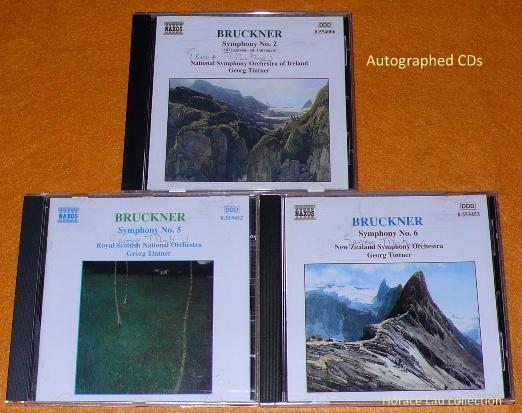
George Tintner was briefly discussed in episode 2. I was fortunate to have had an interview with him when he was in Hong Kong many years ago. His insight in Bruckner and his candid opinion on many past conductors gave me much pleasure when I listened to the tape of the interview again the other day. On that occasion I was honoured to have him autograph the three Bruckner CDs that had been issued at that time.


Günter Wand's Berlin Philharmonic recordings on SACDs have stunning sound. An indispensable part of my collection. The box and the cover art are both a pleasure to see and feel.

Five SACDs and one DVD: My Life, My Music.

Sometimes you just can't have too much of a good thing.

10 May 2011

My Favourite Bruckner Recordings (episode 3) -- Furtwängler's Bruckner recordings.

Before posting my favourite CDs for individual symphonies, I'd like to post some pictures of those sets which I'd never like to part with. These are the ones I mentioned in episode 2.

What comes first is my Furtwängler's Bruckner collection. He left recordings of Symphonies Nos. 4 to 9. Although the war-time recordings of each of these symphonies are extant, only three of them are complete performances, namely the 5th (28-10-1942), the 8th (17-10-1944) and the 9th (7-10-1944).  For the other three symphonies, there remain only fragments of the 4th and 7th, and the last three movements of the 6th. Apart from the fragmented war-time Fourth (14-16 Dec 1941) which I regretted much missing the chance to purchase the Delta issue, I've collected all the extant Furtwängler's Bruckner recordings. Here shows the pile stacking up on a table.


Symphony No. 4:

This Stuttgart performance was only 1 week earlier than the Munich recording but in much better sound. The interpretation was similar.

The sound is just acceptable.


Symphony No. 5:

Among all these issues the new Testament release is of best sound.
This release was from a private copy of tape from Madam Furtwängler, and the sound is dry and rather 'air-less'. The ensemble of the Vienna Philharmonic on this occasion was not first-rate, particularly in the Finale, which might reflect their declining level in this era.


Symphony No. 6:

An almost sensuous Adagio with mesmerizing ritardandos, and a white-hot Finale.


Symphony No. 7:

Fragments for Furtwängler completists.

The only studio recording in Bruckner by Furtwängler, but this Adagio is lovely nonetheless.
The EMI Historical release has a warmer sound than the HS-2088 Japanese release on the right. On the whole this recording sounds better than the two made in 1951 (below).

Basically the interpretation is more or less the same as the one made in Rome 8 days later.

The sound is not good in this Music & Arts release. Need to find a better transfer to replace this one: either Tahra or Delta.


Symphony No. 8:

The sound in the Altus release is surprisingly good.

The Japanese HS-2088 release is a failure, in an attempt to 'clarify' the sound and add artificial stereo, the remastering just resulted in a thin, rather metallic and separated sound.

This recording of the concert at the Titania Palast is marred by somewhat intrusive audience noise.

The reading is quite different from the other recordings made earlier, and is quite compatible with the serenity evident in the late Furtwängler style.

Symphony No. 9:
Coupled with Symphony No. 7 in the DG Double shown above. This recording is a quintessential example of the lure and power of Furtwängler.

06 May 2011

My Favourite Bruckner Recordings (episode 2)

It's really nice to do some housekeeping from time to time. In the case of my Bruckner recordings collection, it provides an opportunity for me to meet my old friends so to speak, e.g. Schuricht's EMI recordings, van Beinum's, and revisit some relatively new ones.

For all lists, there are bound to be some omissions considered blatant and of course inclusions considered illaudable or even downright third-rate by "those in the know". I'd be the least disturbed by these. I believe everyone's choices should be respected so long as there is no intent of malice or discrimination. This is indeed the true beauty of freedom of speech. One example is Kurt Sanderling's Bruckner 7th on Hänssler, which I consider one of my best loved Bruckner 7th recordings. The Gramophone review written by their famous Bruckner reviewer Richard Osborne, however, just showed his dislike of this recording, and concluded with this statement, "Even if it was being offered gratis I would probably grudge it shelfroom." (transl.「就算這是免費贈送,我也可能不願騰出櫃裏空間放置它。」) So there you are. Please take my choices and opinion with a grain of salt!

There are some recordings by a few conductors which I think do not belong to the list of favourite individual symphonies; they are considered en bloc, with good reasons. Georg Tintner is one of them. To be honest, not many will remember the exact name of the orchestras with whom he recorded his Bruckner symphonies, and thus in a sense Tintner "single-handedly" made a name for himself as a reverential Brucknerian. It is his special way of Brucknerian music making that runs through all of his Bruckner recordings. This personal imprint also applies to Furtwängler, "the special one", and Celibidache in his Munich years. Those recordings are all marked by their unmistakable personal stamps. They are in a league of their own. I'm not saying that theirs are all better than other Bruckner recordings, but comparing them with others is almost pointless, so these 3 "groups" will not be included in the favourite list even if I like them very much.

Günter Wand is another special case. He has too many Bruckner recordings to love them all. However, his recordings with the Berlin Philharmonic formed an integral part of his Indian Summer legacy and also of my unforgettable experience, over the years, of dying-for anticipation of the next release to come. Having been issued in the SACD format lately, these five symphonies have secured a firm place in my heart and my shelf.

Happy listening to all Brucknerites.

23 April 2011

My Favourite Bruckner Recordings

Before the Easter holidays, one of my friends asked me, "Why didn't you have a list of your favourite Bruckner recordings on your blog, as you've already had a list for Beethoven symphonies?" Oh yes, and I just couldn't answer. I've never thought of this question, and in retrospect, it is indeed strange that a downright Bruckner fanatic like me has never kept a list of my favourite Bruckner symphonies recordings, not to speak of telling it to others. Of course there must be some recordings or concerts that occupy a special place in my heart, but the problem is, I've never systematically made up a favourite list. I've come to like many recordings, but I seldom think about my top 5 or top 10 in any symphonies, maybe because I thought I didn't have to. Now the situation has changed. This has something to do with the storage of my CDs. I place my Bruckner CDs in three different cabinets. Most of the collection is in 4 shelves fully packed according to conductors in alphabetical order.  However as Furtwängler is considered sui generis, his CDs have their own shelf in another cabinet. Then there is a shelf in a large book cabinet with glass doors in the sitting room dedicated for special categories: Bruckner recordings with the Wiener Philharmoniker and box-sets and separate CDs by my favourite Brucknerians, e.g. Sinopoli, Wand, Karajan, Celibidache, and lately Blomstedt. It sounds and indeed looks confusing.

With all the terrible disasters happening in recent times, it becomes imperative that I need to place all my favourite Bruckner CDs in one place for the ease of evacuation just in case. And so the list. I'll take advantage of this "long" holiday of 4 days to compile this list, and at the same time backup these CDs. Not an easy task I can assure you.