Showing posts with label Celibidache. Show all posts

02 July 2012

Titbits about Celibidache and his reunion with the Berlin Philharmonic Orchestra in 1992


With the imminent release of the DVD and Blu-ray of the historic reunion of Celibidache and the Berlin Philharmoic Orchestra in 1992 on Euroarts, it is perhaps the right time to take a look at some titbits about this event which aroused much interest in the muscal world.

Celibidache's last concert with the Berlin Philharmonic before he left this orchestra was on 29 November 1954, in Bartok's Concerto for Orchestra. A few days before that, on 25 and 26 November, Celi had conducted Brahms' German Requiem to great acclaim from the public and critics alike. However, according to Klaus Lang, in The Karajan Dossier, "behind the scenes there were violent diasgreements between orchestra and conductor, as Celibidache -- the meticulousness of whose rehearsals bordered on the fanatical -- accused the players of incompetence and total lack of discipline". This would lay the foundation for Celi's inability to realise his dream of succeeding Furtwängler. Between the end of WWII and the death of Furtwängler on 30 November 1954, Celibidache gave at least 414 concerts with the Berlin Philharmonic, compared to Furtwängler's 222 and Karajan's mere four. Those were difficult years in post-war Germany and Celibidache had managed to help the Berlin Philharmonic to restore its former high artistic standard. Thus, no one will find it hard to envisage that Celibidache was sorely disappointed when Karajan was appointed Furtwängler's successor. He left Berlin and its world famous orchestra.


Some would ask why Celi did not return to conduct the Berlin Philharmonic Orchestra. In an interview with the veteran BPO intendant Wolfgang Stresemann in April 1978, Klaus Lang noted the following conversation, again in his book The Karajan Dossier. He asked Stresemann, "You continued to work with the Romanian maestro when you were intendant of the Berlin Radio Symphony Orchestra (*)...... Why is it that, ever since Celibidache and the Philharmonic parted company, he's avoided the orchestra?" (*from 1956-1959)

Stresemann's answer was like this:
"You know, I'm not familiar with the background of all this, since it wasn't until 1955 that I returned to Berlin. Immediately after the war Celibidache did a great deal for the Berlin Philharmonic Orchestra, but I've been told that he expected to be appointed Furtwängler's successor. He was no doubt very disappointed by Karajan's appointment and, although, I may be wrong, I think he now feels a kind of love-hate relationship towards the Philharmonic. He's often attacked the orchestra in public, which isn't exactly helpful and which is why I believe concerts with him would immediately be fraught with tension. I think it's much better if he comes to the Philharmonie with other orchestra -- as he now does on a regular basis. That he's an exceptional conductor has never been in any doubt." (pp. 132-133).

The ice was finally broken in 1990, thanks to the then German President Richard von Weizsäcker who wrote a letter on 9 November 1990 to Celi congratulating him on the success of his recent Japanese tour with the Munich Philharmonic, and sincerely asking him to consider a reunion with BPO. He added that, "It would be a real feast for me, for the Orchestra, for Berlin and the whole musical world". What a compliment!

Celi replied on 22 November 1990 and in the letter he wrote: "Thank you very much for the invitation to conduct the Berlin Philharmonic after a long time. It is my great honour to accept the invitation."

The time and venue were then fixed to be on 31 March and 1 April 1992 at the Grosser Konzertsaal, Schauspielhaus Berlin. As Philharmonie Berlin started its renovation in April 1992, the concerts could not be performed there. This would be a benefit concert for children in Romania. That time slot was originally allocated to a benefit concert by Leonard Bernstein, but as he died on 14 October 1990, the German President was quick in thinking of the perfect replacement.

Celi asked for 6 rehearsal sessions for the single work in these two concerts, Bruckner's Seventh Symphony. So much rehearsal time was unusual for a work the BPO was so familiar with, but they were ready to oblige him this time. In fact Barenboim had just recorded this symphony with the BPO in the preceding month. The result was fruitful to both however, with final mutual understanding evolving from the initial skeptical exchanges.

The rehearsal scene was depicted in some detail by Klaus Umbach in his book Celibidache -- der andere Maestro (pp. 83-86). During the first rehearsal on 27 March 1992, orchestral members described it as " a marathon". To get an idea of why they said so, Celi spent half an hour to rehearse the G#-G-F# tremolo of the first violins in the first 11 bars. He would not take any "Nebula" or wishy-washy tremolo, and he wanted very clear, very precise and very quiet ones. Umbach remarked that Celi rehearsed not only Bruckner, but also his infamous art of cold shower. One example was, on their first notes, Celibidache told the double basses they were like "a women's orchestra in Florida" and "Thin, so thin".

On the second day, he said, "You are wonderful, but not symphonic". Things became a little better in the third rehearsal when Celi said, "This time it is symphonic. But merely a false drama. Transparency is the ultimate aim. You should listen to each other." Then he wanted the Berliners to know what his Munich Philharmonic players' "deutsches Vibrato". 

On the fourth rehearsal day, there was "trust" and Celi would mutter "thank you". During the break, he said, "I'm very reassured that there is spontaneity. See how they react, a direct translation of what I tell them. Much is indeed unusual of them, but even if not everything works out, it will be a wonderful concert."

The concert did turn out very well. And the rest, as they say, is history.

05 June 2012

The falsification of Celibidache's Bruckner concerts at your home -- an emerging partial cycle

For Celibidache, an audio or video recording of his concert is not his concert at all. The dimension of space is absent in the recording, according to his understanding of the phenomenology of music.

For lesser mortals like us, these recordings are the only things that can approximate his concerts, apart from the memories that exist in the brains of those who have attended his concerts in person. In fact memories are still not equivalent to the experience at the time of the concert when the music was playing. Hence in 2012, the only practical and existential way to get in touch with Celibidache's Bruckner concerts is by way of recordings, be they audio or video.

Thanks to the coming releases of DVDs of his Bruckner concerts, one can finally experience a falsification (I'm sure Celi would have insisted this word) of a partial cycle of Bruckner symphonies from No. 4 to No. 9 being played in one's home theatre or computer or whatever one feels like to use. Here is the playing list:

Symphony No. 4 -- a newcomer from Arthaus Musik (101645)

Munich Philharmonic 1983

The following is from the back cover:

The Romanian conductor Sergiu Celibidache (1912-96) was one of the most adamant personalities in the music world. He rehearsed three times as much as other conductors and avoided making recordings because he believed they were a false representation his musical intentions. This concert from the Herkulessaal in Munich captures one of the rare occasions on which he consented to a recording being made. He conducts the Munich Philharmonic Orchestra with Anton Bruckner’s “Romantic” Symphony No. 4 in E flat major.
Also included is an interview with Sergiu Celibidache about conducting Bruckner’s Symphony No. 4.

Symphony No. 5 -- again from Arthaus (101639), Munich Philharmonic 1985 (Picture here)

Symphonies Nos. 6-8 -- from Sony, Munich Philharmonic (Picture here)

Symphony No. 7 (Berlin version) -- from EuroArts (2011408) (Picture here)

Symphony No. 9 -- from Opus Arte, Denon or TDK, Orchestra Sinfonica di Torino della RAI 1969

If you feel like, you can add Bruckner's Mass No. 3 in F minor from Arthaus (100251) to complete the 'cycle'.

This 'cycle' will be available by mid-July 2012.

The only regret is that there is still a Munich Philharmonic B9 DVD wanting. One can only hope.

30 May 2012

The legend lives on -- thanks to historic Celibidache video recordings

There is a legendary ephemeral laser disc/VHS much talked about in the circle of Celibidache fans.  The length of the performance of this Seventh Symphony of Bruckner at more than 86 minutes was once the longest on gramophone records, until 2007 when Toshiyuki Kamioka usurped it with a reading of stupendous length (at 91 minutes). However, apart from the length, I found nothing else in Kamiola's recording that surpasses Celi's.

The occasion on which this Celibidache concert took place was historic. Celibidache's last concert with the Berlin Philharmonic before he left this orchestra was on 29 November 1954. Between the end of WWII and the death of Furtwängler on 30 November 1954, Celibidache gave at least 414 concerts with the Berlin Philharmonic, compared to Furtwängler's 222 and Karajan's mere four. Those were difficult years in post-war Germany and Celibidache had managed to help the Berlin Philharmonic to restore its former high artistic standard. Thus, no one will find it hard to envisage that Celibidache was sorely disappointed when Karajan was appointed Furtwängler's successor. He left Berlin and her world famous orchestra. He was to return to conduct this orchestra only after almost 38 years. It is a very long period of time in the career of a conductor.

This historic return to the Berlin Philharmonic was filmed by Sony and released on laser discs/VHSs soon after the performance. But they were difficult to come by. At that time some of my friends even thought that its existence was only a myth. I have listened to this concert on a pirate copy and, to be honest, although I could not prove categorically that it was from this historic concert, I firmly believed that it is from Celi, with all his trademark touches throughout.

The legendary reunion concerts with BPO

That this concert could materialise at long last was the result of the work of the then German President Richard von Weizsäcker who wrote a letter dated 9 Nov 1990 to Celi congratulating him on the success of his recent Japanese tour with the Munich Philharmonic, and sincerely asking him to consider a reunion with BPO. Thirteen days later, Celi replied that it would be his great pleasure to accept the President's invitation.

The time and venue were then fixed to be on 31 Mar and 1 Apr 1992 at the Grosser Konzertsaal, Schauspielhaus Berlin. As Philharmonie Berlin started its renovation in Apr 1992, the concerts could not be performed there. This would be a benefit concert for children in Romania.

According to reports, Celi demanded 6 rehearsal sessions for the single work in these two concerts, Bruckner's Seventh Symphony. So much rehearsal time was unusual for a work the BPO was so familiar with, but they were ready to oblige him this time.  The result was fruitful to both, with final mutual understanding evolving from the initial skeptical exchanges. (Euroarts 2011408)

10 Nov 1985

Another eagerly awaited DVD (Arthaus Musik 101639) is another famous Celibidache concert, on 10 Nov 1985 on the opening of the Gasteig in Munich. Not surprisingly it is also a Bruckner concert, of Symphony No. 5. An alleged recording of this concert was issued by Audior in 1997 (AUDSE-523-4). It was a spellbinding experience, I'd say.

Together with the 2 sets of DVDs mentioned in my previous post, we will soon be enjoying 4 sets of Celibidache DVDs. It is a veritable treasure trove for Celi fans, in time to commemorate the centennial of Celibidache's birth. This 100th anniversary was celebrated in Romania and recognised by UNESCO.

P.S. Günter Wand, who was born in the same year as Sergiu Celibidache, is not graced by Germany with an anniversary celebration in such a scale, or at all. Nevertheless he is deeply honoured in my heart as much as Celibidache.


29 April 2012

April showers bring May flowers

We indeed had many showers and thunderstorms here in Hong Kong in April this year, a little too many compared with previous years. On the other hand I could only find very few CD releases that interested me in April, the EMI Schuricht/VPO Bruckner's 8th and 9th SACD being the only one that comes easily to mind. Barenboim's magnificent Bruckner's 7th was released in late March. As the saying goes, April showers bring May flowers, so I'm looking forward to many attractive CD releases, as well as beautiful flowers, in May.  Let me share with you some of the notable ones.


Celibidache's video products have always been much-sought-after items, and chances are if you miss it in the first batch of release, you'll more often than not miss it altogether. Now EuroArts will give us a treat in the form of a 5-DVD box set. All have been previously issued, but it is the first time that they are grouped together in one convenient box set. It contains the piano concerti of Schumann, Tchaikovsky (No. 1) and Brahms (both) with none other than Daniel Barenboim at the piano on DVD1 and DVD2, Dvorak Symphony No. 9 and Prokofiev Symphony No. 1 on DVD3, and Ravel and Debussy on DVD4, all with the Munich Philharmonic. DVD5 contains Rimsky-Korsakov's Scheherazade and Richard Strauss' Till Eulenspiegel, this time with the Radio-Sinfonieorchester Stuttgart des SWR.


Bruckner fans are not forgotten as well. The long out-of-print LDs and VHSs of B6-8 will now be reissued in 3 newly remastered DVDs, coupled with a "re-discovered" audio recording of B4 in 2 CDs, of concerts on 5&6 February 1989 in Musikverein, Vienna. It was a significantly slower reading than the one performed 4 months previously in Gasteig, Munich issued previously in the EMI set (about four minutes longer in the Adagio and more than three minutes longer in the Finale, discounting the applause recorded at the end). It was reportedly due to Celi's meticulous adjustment of tempo according to the acoustic of the performing venue, i.e. shorter reverberation in Munich.


When Bruckner is mentioned, how can we not come to the ubiquitous Günter Wand? Following the issue of his Bruckner recordings with the Berlin Philharmonic in a budget box set in January 2012 (RCA 88691922952), and those in Cologne included in the Günter Wand: The Great Recordings 28CD+1DVD box set, now comes a Korean release of 33 CDs of his live recordings on RCA (RCA S70845C) in the late 1980s till his last recording, including all his Bruckner recordings with NDRSO and BPO, apparently filling the gap left by the The Great Recordings set. What is particulary tempting is the inclusion of his only recording with the Chicago SO in 1989 of Brahms Symphony No. 1 which I praised in a previous post, and his incomplete live Beethoven cycle (lacking the 7th -9th) with NDRSO, with excellent Eroica, 4th, 5th and 6th.


Here comes a major reissue from Universal Italy: The Art of Giuseppe Sinopoli, a 16-CD box set featuring many out-of-print recordings, among which are his lovely Beethoven's Ninth, and Ravel's Bolero and Daphnis and Chloe suite. A little disappointing is the inclusion of only two of his Bruckner recordings, the popular 4th and 7th, which IMHO do not serve as good examples of how wonderful a Brucknerian he is. Yes his 5th and 9th may still be in circulation and thus not "allowed" in such a set, but why not his superb 3rd and 8th?


Michael Gielen's Beethoven recordings referred to in the post

When Beethoven symphonies recordings are mentioned, how can I forget Michael Gielen?  This is not the reissue of his recordings in the EMI set (recorded in 1986-1994), but a newly remastered audio products of his live recordings (recorded 1997-2000) issued on DVDs by EuroArts. Sample excerpts can be found here. The Eighth within this cycle has been issued by Hanssler before (CD93.56) but I don't know if there is a new remastering for the present release.


Claudio Abbado's Bruckner recordings with the Vienna Philharmonic may have received at best luke-warm reception in the past, but his performances with the Lucerne Festival Orchestra in recent years have made him a master Brucknerian of wide acclaim. His 4th is among one of my favourites. And now comes the 5th on DVD and BD (Accentus ACC10243BD), recorded in performances on 19 and 20 August 2011 which were highly lauded in the press.

31 August 2011

Another chance to acquire the inimitable Celibidache EMI Bruckner set

The Celibidache EMI Bruckner box-set is going to reappear in a new reissue next month. Those who missed out this box-set in the past can now have another chance to grab it. Inimitable in every way is Celibidache's late style in Bruckner from his Munich years. It will be released in Japan in mid-October with a listed price of 3770 Yen (c. US$49) -- quite a bargain. (Update: UK release on 24 Oct, at 27.50 quids, and there are discounts everywhere.)


The repeatedly delayed B7 and B8 discs from Kent Nagano on Sony are now on their way to the store shelves with the CD covers revealed. Judging from his previous recordings of Bruckner symphonies (Nos. 3 & 6 with DSO on Harmonia Mundi, No. 4 with Bavarian State Orchestra on Sony, and a DVD of No. 8 with DSO on Arthaus Musik), I have some expectations from the new ones. With his rumoured departure from Munich in 2013, any further Bruckner recordings with this orchestra will remain a doubt, although it may be too early to say that.


(5 Sep 2011 Update: The Nagano B8 release is once again postponed, this time to Feb 2012!!)

11 May 2011

My Favourite Bruckner Recordings (episode 4) -- Celibidache, Tintner and Wand

Sergiu Celibidache in his Munich years is a love-it or hate-it affair for Brucknerites, and opinions can be polarised. What cannot be argued is that his recordings in that era is in a league of his own.  My collection has been posted previously:

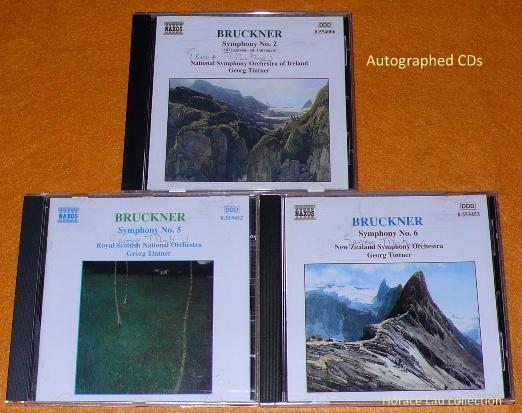
George Tintner was briefly discussed in episode 2. I was fortunate to have had an interview with him when he was in Hong Kong many years ago. His insight in Bruckner and his candid opinion on many past conductors gave me much pleasure when I listened to the tape of the interview again the other day. On that occasion I was honoured to have him autograph the three Bruckner CDs that had been issued at that time.


Günter Wand's Berlin Philharmonic recordings on SACDs have stunning sound. An indispensable part of my collection. The box and the cover art are both a pleasure to see and feel.

Five SACDs and one DVD: My Life, My Music.

Sometimes you just can't have too much of a good thing.

08 November 2010

New picture added

A new picture was added to "My Celibidache collection many years on". It shows the new Altus CDs on his tours in Japan in 1986 and 1990.

28 March 2010

My Celibidache collection many years on

When I started to collect Celibidache's sound and video recordings many years ago, the official EMI and DG releases were unheard of, and was plain wishful thinking at that time. This is a journey full of frustrations and joy, sometimes all mixed together in one go. It all started with those releases from minor pirate labels here and there, and then came the plethora of CDs of his Munich concerts from what we somewhat affectionately called the "violet" and "green" discs (from Meteor and Audior respectively) among our circle of Celi fans. That was a joyful period for our ears but painful for our pockets, for these CDs didn't come in cheap.

The classical music world was then taken by storm with the announcement of official releases from EMI of his Munich recordings. It was a time of great expectations. Not long after that DG stepped in with a view to share the pie. The initial project target was almost too good to be true: to release all Celi's recordings held in radio or concert hall archives. But it was doomed as sales volume dropped when more and more box-sets were issued. We thought we would have no more of new releases.

Not until 2008 did we see a resurrection of this project masterminded by Celi's son. It was the very important box-set from Orfeo of Celi's brief Cologne period. I'd say it shows Celi's rite of passage to his future artistic aspirations and cult status.

Let's see the pictures arranged in roughly chronological order of Celi's career.

 Recordings of his years leading the Berlin Philharmonic issued by Tahra

His studio recordings: Tchaikovsky Symphony No. 5 and Nutcracker Suite (LPO/Decca), Prokofiev Classical Symphony,  Mendelssohn Violin Concerto with Siegried Borries (BPO/EMI) and Brahms Violin Concerto with Ida Haendel (LSO/EMI). These CDs are Japanese releases.

An important document of a brief period. I like these CDs very much.

The Fonit Cetra set of his Italian years.

This Celi recording is also included in the DG set.

The rather ill-fated DG releases.

The age of pirates.


The international version.

My treasured collection of the Japanese limited edition.
Believe it or not, the CDs have better sound than the international release.


The new releases from Altus for his tours in Japan.


The video products:


(Not included are  a few DVDs. A new pictures was added on 8 Nov 2010.)

An almost guilty pleasure, I have to admit.