21 May 2011

My Favourite Bruckner Recordings (episode 6) -- What are my criteria?

One of my friends asked me yesterday, rather bluntly but with no malice. "Why did it take so long for you to post your favourite Bruckner recordings? It's not difficult to just give me a list?" I was a little taken aback. My frank answer is, "I'm too fastidious."

Yes, I'm a fastidious person, particularly in classical music. Maybe that's why I like Bruckner's music so much, as I suppose he was also fastidious. When I decided to compile a list of my favourite Bruckner recordings, I prepared seven flash cards, each dedicated to one symphony, from No. 3 to No. 9. I just jotted down my choices off hand. Then I went to my CD shelf and briefly browsed through my collection to see if I'd left out some which did not come to mind in the first place. I understand that some will say those which do not come to mind in the first place should be no good. There must be some truth in this statement, but I reckon that I don't have an elephantine memory and I have quite a lot of Bruckner CDs, so this sort of reminder is necessary for me, especially when I'm preparing a list of many and not a single favourite for each symphony.

Then I had to take out all the CDs in my draft list and listened to all of them once again to see if the impressions in my memory are still valid. With so many new additions in the past ten years, some old warhorses are bound to come up to great competition. So it takes time. Too short a list may just be too biased and oversimplify things unnecessarily. Too long a list will render it useless. However there is no magic number. My initial decision is around 6 for each symphony and if possible list at least one for each version in one symphony (but the total number for each symphony is still around 6). After that I had to scan the covers or take pictures of the CDs.

A big question is: what are my criteria for my favourites? It goes without saying that personal tastes are very subjective, and can be quite different from objective judgement. Some would say why not prepare two lists, one subjective and one objective. I don't agree because I believe that separating objective and subjective choices is too artificial. We live in a world when we base our actions or decisions on both objective and subjective factors; we just cannot segregate them meaningfully. Either way it is biased. When music appreciation is a personal experience, there is no true objectivity in the strictest sense. It also applies to other forms of art. It makes me task no less easier as I have to find the right balance between objective judgement and subjective personal taste, as they are intertwined.

I hope I can make good use of the weekend to post my favourites for Symphony No. 3 shortly.

18 May 2011

My Favourite Bruckner Recordings (episode 5) -- Historical recordings vs. new recordings

It is difficult to define what historical recordings are. Before WWII? Mono? By the same token, one can always say, "how new is new?" Digital rather than analogue recordings? Multi-channel SACDs rather than CDs? How about DVD-Audio (as in one Asahina recording)?

All these of course are relative terms. For practical purposes, I'd take those recorded before 1960 as 'historical' as after 1960 you can have stereo (caveat: some stereo recordings before 1960 are extant). However, I'm fully aware that between 1950 and 1960 there were many mono recordings with very good sound quality. But then a line still needs to be drawn. I'm not a purist and this classification is good enough for me. In order to stay in a comfort zone, I'd take all non-historical recordings as 'new', so as not to make things complicated. Of course you can always argue that there are some newer than others, but again I won't bother about that. So far so good.

Then comes an obvious question: why such a distinction? I reckon that sound quality is an important factor in my enjoyment of recorded music. Yes, interpretation -- again I won't go into the argument of whether a conductor should interpret the music written by the composer:  that is a real Pandora's box -- is also important, but it should not be an overriding determining factor in the choice of my favourite recording. I'm not against historical recordings, even those issued originally in 78s. In fact my interest in Bruckner's music was nurtured by none other than Furtwängler's records which have never been considered of good sound by modern standards.

In fact, in my shortlists of favourite Bruckner recordings, many conductors of the past era are present, namely Böhm, Jochum, Kabasta, Keilberth, Schuricht and Walter. On the other hand, although I found many recordings by Abendroth, Adler, Knappertsbusch and Rosbaud interesting, for one reason or another, theirs still cannot find their way into the shortlist. Horenstein is a special case in this context, which I'll go back to in future.

Having said that, recordings made before 1940, even with undisputed historical or even historic significance, are of such inferior sound quality that I'm not being honest to myself if I say I choose them as my favourites. 

11 May 2011

My Favourite Bruckner Recordings (episode 4) -- Celibidache, Tintner and Wand

Sergiu Celibidache in his Munich years is a love-it or hate-it affair for Brucknerites, and opinions can be polarised. What cannot be argued is that his recordings in that era is in a league of his own.  My collection has been posted previously:

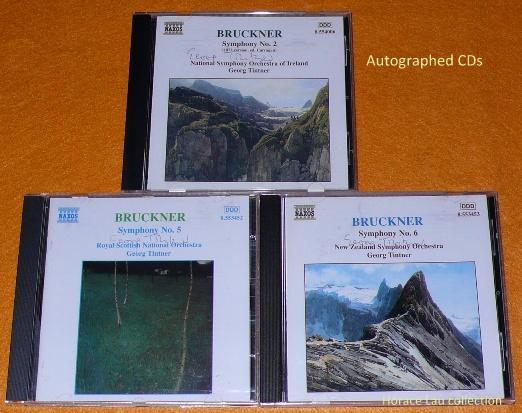
George Tintner was briefly discussed in episode 2. I was fortunate to have had an interview with him when he was in Hong Kong many years ago. His insight in Bruckner and his candid opinion on many past conductors gave me much pleasure when I listened to the tape of the interview again the other day. On that occasion I was honoured to have him autograph the three Bruckner CDs that had been issued at that time.


Günter Wand's Berlin Philharmonic recordings on SACDs have stunning sound. An indispensable part of my collection. The box and the cover art are both a pleasure to see and feel.

Five SACDs and one DVD: My Life, My Music.

Sometimes you just can't have too much of a good thing.